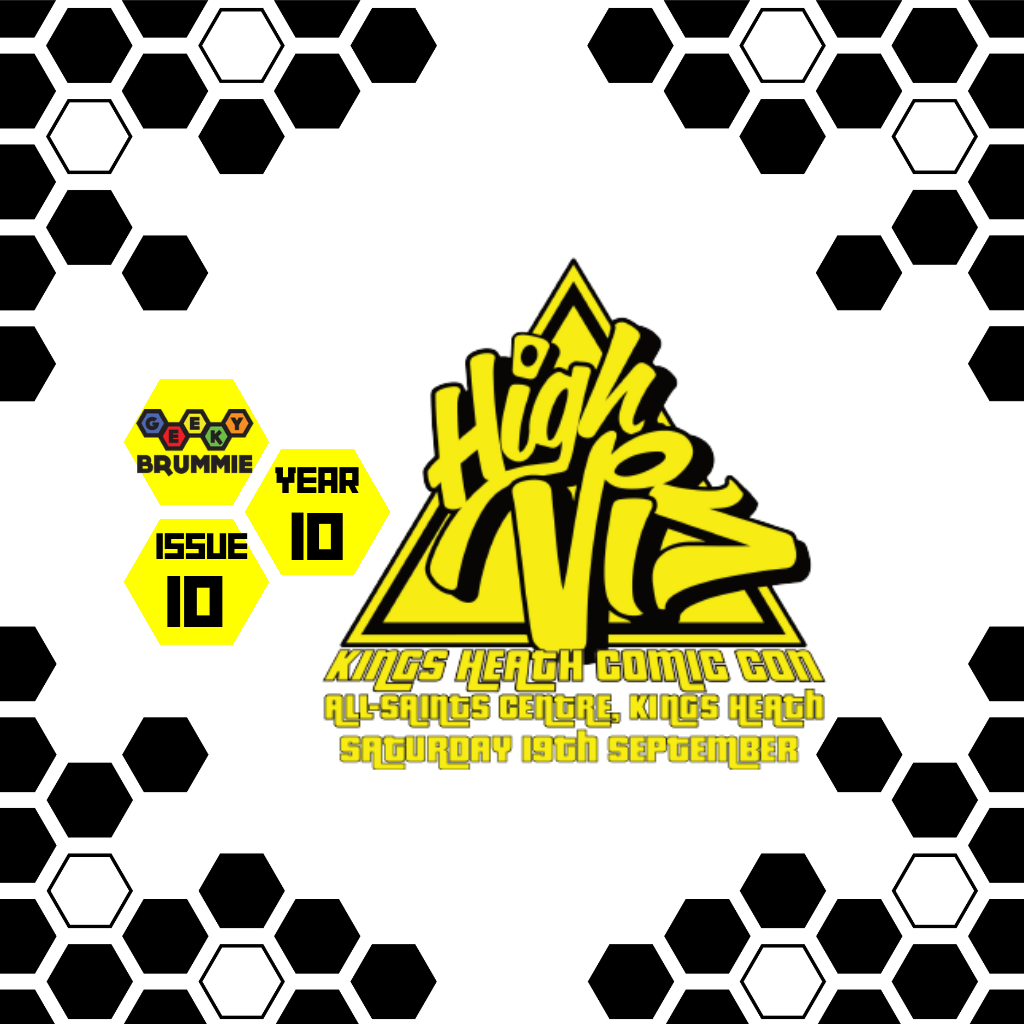
[00:00:00] Speaker A: It's Saturday the 19th of September. We're at the All Saints Centre here at Kings Heath, which could mean only one thing. It's the return of hi Viz Comic Con for year two. Some fantastic guests on today, including Mark Miller, Ian Edgerton, Ian Richardson, Kev Sutherland and a whole lot more. And we're going to take a wander around and introduce you. Oh, by the way as well, it's Pat Mandy.
[00:00:28] Speaker B: Hi, I'm Ian Richardson.
[00:00:30] Speaker A: So Ian, tell us about you and your comics and your working comics.
[00:00:35] Speaker B: What would you like to know? Where do I start working professional from 2002 that long for my series.
Veteran 2000 AD artists.
Marvel UK Xenoscope, Image Comics, Birmingham Born and bred.
Oh, Commando as well, which is my current gig, I should say.
Yeah, that just about covers it. Been doing that for a while now.
[00:01:09] Speaker A: And can you tell us, can you tell us why comic cons like this and smaller independent comic cons are so important?
[00:01:17] Speaker B: I guess in a way for start off it's more about the comics, which obviously is more important to guys like us and stuff.
It's more of a community aspect for us, which appeals to me certainly for a starve, it's more interactive. You get to spend more time speaking to people and finding out what they like, what you like, what you've got in common.
And that's the same as well because it's a hometown show for me as well that goes down well.
[00:01:52] Speaker A: And as it's Batman day today it is. Who is your favorite Batman artist of all time?
[00:01:59] Speaker B: So I've always got a stuff for Jose Louis Garcia Lopez, whatever he does.
But then Jim Apero probably Jim Apero and Neil Adams are kind of even Stevens, but that's me showing my age.
I really like Ivan Rice's Batman actually for recent stuff as well.
[00:02:24] Speaker A: And where can we find information about you online if people want to go and buy your Wonderful Books?
[00:02:30] Speaker B: Instagram, ianrichardson art or Facebook, just ianrichardson. You'll find
[email protected] as an email address and you follow socials from that as well.
[00:02:47] Speaker A: Awesome. Thank you very much.
[00:02:49] Speaker B: Thank you very much. Always a pleasure to see you chaps.
[00:02:53] Speaker C: I'm Hunt Emerson.
I've been drawing comics in Birmingham for over 50 years about getting on for 55 years now and well, I'm almost finished.
[00:03:10] Speaker A: So what got you into comics and creating comics in the first place?
[00:03:13] Speaker C: I got into comics in the first place through seeing the American Underground, Gilbert Shelton, Robert Crumb and those guys.
And I'd Been at art college and got nowhere. So I decided that's really what I wanted to do. So I set about teaching myself to do it.
And I've been doing it ever since. Gradually developed my own characters, published books through. Mainly through Knockabout Comics. I've done about 30 comics albums, comics books over the years, and it's all I could ever do, really.
[00:03:51] Speaker A: So how do you feel about smaller comic conventions like this, the importance of smaller comic conventions and independent comic conventions?
[00:03:57] Speaker C: These sort of gigs are really good. You know, you get people. I get people who've been following me work for a long time and they come and they actually have the chance to meet me. I don't do nearly enough of these events. I'm going to try and do more in this coming year. But this is great.
It's a nice place and it's. It's really busy.
[00:04:19] Speaker D: Good and busy.
[00:04:21] Speaker A: And if people want to buy your art, where can we find you online?
[00:04:25] Speaker C: I've got a good website called largecow.com with a shop and there's lots of artwork there and books for sale.
And you can get in touch with me if you want. But I don't really do commissions anymore. I'm kind of trying to retire.
You know, I've been doing it a long time now.
Time to take. Take some time out. It's not easy though, when you're a freelance. Retiring.
[00:04:54] Speaker A: Brilliant. Thank you very much.
[00:04:55] Speaker C: Thank you.
Have a good day yourselves. And you read lots of. Have you seen John yet? John McCrae.
[00:05:03] Speaker E: Good.
[00:05:04] Speaker A: He's the man.
Okay, thank you very much.
[00:05:07] Speaker C: Thank you.
[00:05:08] Speaker F: Thank you.
[00:05:46] Speaker D: Hi, I'm Ian Edgington, comic writer extraordinaire.
[00:05:49] Speaker A: Hi, Ian, thank you for joining us.
Can you tell us more about what got you into comics and what were your inspiration to go into comic art?
[00:05:56] Speaker D: I got into comics back in the dim and distant past, when dinosaurs ruled
[00:06:00] Speaker A: the earth kind of thing.
[00:06:02] Speaker D: I will tell you, it was in black and white and shop shut on Wednesdays.
It was just. There was nothing. I grew up reading, like Lion, Valiant and Hotspur and things like, you know, all those kind of classic Boyzone kind of comics.
[00:06:13] Speaker A: Yeah.
[00:06:14] Speaker D: When 2000 AD came along, and of course it was up with the advent
[00:06:17] Speaker A: of punk and everything.
[00:06:18] Speaker D: It was a real kind of like shot in the arm and it's like you go, oh, okay, this is different.
And so I actually consistently picked up 2000 AD from then.
I used to work on a Saturday as a Saturday by my local spa.
And when I had my lunch, I would go pick up the 2000 ad, buy a sandwich and sit on the step outside and read the 2000 AD every Saturday.
And I did not realize it. Years later I would end up working for them. And so that was my kind of slow, painful grind into becoming a comics writer.
[00:06:49] Speaker E: Basically.
[00:06:50] Speaker A: What is about events like this and local comic conventions and is it more of an opportunity to connect to people?
[00:06:56] Speaker D: It's great to meet people on a one to one basis. A lot of the big conventions these days are celebrities. Funkos, nothing against that, but it's very much of a broad strokes thing where people come here for certain kind of writers, comic artists, and you get to engage with people on a kind of more chatty and intimate level. You actually get to see people who you've seen at other conventions like Lawless or Thought Bubble and you see them again and you remake those connections.
And I think it's great for the community because it's on a closer, smaller level, but also it's a lot more intimate and friendly and you've got time for people to chat and see the same faces again too.
[00:07:38] Speaker G: It's.
[00:07:39] Speaker D: I like the smaller one like this. I like the big ones as well because you get to see like famous film stars and the big broad stripes. But these ones, you know, it's just like a nicer hometown feel.
[00:07:50] Speaker F: Thank you.
[00:07:51] Speaker A: And as it's Batman day today, do you have a favorite Batman writer or artist?
[00:07:55] Speaker D: Ooh, Batman writer.
I mean he only did a couple of Batman things, but Mike McNola is my. I think basically this might Beignola because he did a Batman one shot Legend of Dark Knight and then Gotham by Gaslighting.
I liked when Alan Grant had a run on Batman back in the 90s, early 2000s and then you had Neil Adams and all that kind of stuff as well. But yes, the mignona Batman stuff because I think I really like the Gothic Y vibe. And then I just like the Alan Grant stuff, I think because he bought a 2000 A.D. kind of feel to it.
So yeah, that's.
[00:08:29] Speaker A: Thank you. And if you want to buy your art and books, where can people find you?
[00:08:33] Speaker D: Online, sadly. I am a Luddite, so I only have a Facebook page, but you can find my stuff on Amazon and things like that and so on. And I very do conventions like this.
[00:08:45] Speaker A: Brilliant. Thank you very much for joining us.
[00:08:46] Speaker D: No worries.
[00:08:47] Speaker G: Hi, I'm Matt Brooker. I draw comics under the pen name Disraeli. I work pretty much exclusively for 2000 AD these days.
The last couple of years I've been drawing a series called Helium, which is a kind of steampunk thing set in a world that's covered in a toxic cloud.
Before that, I was with myself and Ian Edgington. We were doing a whole bunch of War of the World sequels under the name Scarlet Tracers.
[00:09:15] Speaker A: What got you into art and comics in the first place?
[00:09:18] Speaker G: Right? I mean, I always loved drawing, but I sometimes think that the thing that really got me into art was revenge.
I had this teacher that I absolutely hated when I was about 10 years old, and she was always telling me to kind of get my head out the clouds and concentrate and this and that. And I became almost determined to find somewhere making a living where I would just kind of be sort of noodling around and kind of.
And sort of just kind of somehow making a living from the random stuff that came up in my head. And this is as close as I've managed, really.
And it's been great. It's like being the little boy who wanted to be an engine driver when he was a kid and getting to be an engine driver and finding out as good as you thought it was. It takes a particular kind of personality, I think, to enjoy doing it.
I am very well adapted to sitting in a room for hours at a time just going like.
But if you've got that kind of personality and this. This kind of life, like, suits you down to the ground.
But I had a long period where I wasn't sure if I wanted to do comics or more sort of science fiction illustration type stuff. So I had this big kind of, you know, this, like, one of those sort of like, Elvis on the Ed Sullivan show moments that sort of changed July. And for me, funnily enough, it was finding the art book for the movie Alien, because that pulled together a whole bunch of stuff. There was, like, Chris Foss in there, who was like the king of sci fi book covers. But at the same time, another one of the designers on that movie was Mobius, who was like one of the great European comic artists. And so it was like, through that, I ended up discovering European comics. And in the early 1980s, we did a lot of family holidays in Belgium and France, and I would go around the comic shops hoovering stuff up.
[00:11:25] Speaker E: Awesome.
[00:11:25] Speaker A: Thank you. And what's the importance about local comic conventions like this and independent comic conventions?
[00:11:31] Speaker G: I mean, I think it's. I think what's great about it is it's a real point of contact between creators and between fans and also an opportunity for fans themselves to make contact with each other and to sort of form friendships and form networks.
The thing about comics is it can be a very isolated activity, both in the making of it and the reading of it.
Like, for most of the year, if everything I did when I sent it off to the publisher basically got chucked in a shredder and never seen again, I wouldn't actually notice much of a difference as long as they kept paying me. But it's when you come to a convention and you actually talk to people, you discover, oh, yeah, people are actually reading this stuff and you find out what parts of it they enjoy, what parts aren't working so well.
It gives you a bit of an opportunity to kind of tweak what you're doing and get feedback. And I think simultaneously, I think for fans, there's this thing of like being able to get somewhere easily and conveniently find people who share an enthusiasm with you. I mean, that was very important to. To me.
I mean, I started out in, like, very early 80s. There really weren't that many comic conventions around. But funnily enough, the first one I ever went to from Sheffield was actually a comic convention in.
In Birmingham. It was. Oh, edgbuston.
That was the first one I ever went to. And there's a whole bunch of people I met there that kind of sort of help that helped me sort of build a community and interesting comics moving forward.
[00:13:10] Speaker D: Thank you.
[00:13:11] Speaker A: And as it's Batman day to day, on the day of recording, is there a particular Batman artist that you would say is your favorite?
[00:13:17] Speaker G: I mean, my. Mine's probably going to be a bit cliche because I was more of a Marvel bod than a DC bod growing up. So really like the Batman that I. The first Batman that I remember is Dark Knight, but I think probably David Mazzucchelli. David Mazzucchelli on year one. I actually just love the simplicity of his stuff. I mean, it's absolutely gorgeous.
[00:13:40] Speaker A: Thank you very much. And where can we find you online if you want to see all commission art?
[00:13:46] Speaker G: Really, I'm pretty much just on Instagram now as Disraeli Demon, and I'm not on that very much. But if you. If you want to. If I always say my Instagram, if you want to go to the last place, you'll know what I'm doing, anything, that's. That's the place to go. The last place we knew about me will be my Instagram.
[00:14:05] Speaker A: Thank you very much.
[00:14:06] Speaker G: Okay, cheers.
[00:14:31] Speaker H: Hi, my name is Mark Jackson. I'm a cartoonist.
I write and draw comic books primarily for all ages. So a lot of fantastic comics for kids. I also publish a comic called Goof, which is me and lots of other cartoonists.
I also run a comic art studio in Macclesville where I live with my wife Jane called Room for Comics, where I dedicate to teaching comics.
We also run our own comics festival, Macpow, so we celebrate fantastic events ourselves and like this. So, yeah, that's me.
[00:14:59] Speaker A: What grew you to comics and art and illustration in the first place?
[00:15:04] Speaker H: I used to draw when I was little. I can only imagine I was just drawing all the time and then suddenly I was handed comics, probably something like the Beano, and then it just clicked. The writing, the drawing, the writing, the reading, it all was kind of one thing for me. So, yeah. And I've never, never really stopped.
[00:15:24] Speaker A: Brilliant. Thank you.
Local independent comic conventions. How important do you feel they are to support the comics industry in the uk?
[00:15:30] Speaker H: Oh, they're really important because the great thing about them is that for the most part they'll focus fully on comics.
So I mentioned the comics festival that I organise. We only focus on comics and people who are making comics and all the other stuff can be left for the big conventions.
But I want to. If it's a comics, comics is in the name. Comics need to be on your table, so they're really important.
[00:15:50] Speaker A: Thank you. And as it's Batman Day, as we're recording, this is a particular Batman artist or writer that you think is your favorite Batman artist?
[00:15:57] Speaker H: Oh, God. Well, you know, I've got to go with Frank Miller.
I loved Dark Knight Returns and Klaus Janssen, his work.
But if you were going to ask me my favorite Batman, I'd obviously go Adam West.
[00:16:14] Speaker A: There you go. Awesome. And where can we find you on social media and online?
[00:16:17] Speaker H: Yeah, so I'm Mark makes comics on social media. Mark with a C. And my website is markmatescomics.co.uk and yeah, everything's there. So you can find lots of social media, lots of comics, comics, comics, comics.
[00:16:31] Speaker C: Brilliant.
[00:16:31] Speaker A: Thank you very much for joining us today.
[00:16:32] Speaker H: No problem. Thank you.
[00:16:51] Speaker I: Hi there. I'm John McCrae. I've been drawing comics for nearly 40 years and I guess I'm best known for a character called Hitman that I drew for five years with Garth Ennis writing it for DC Comics. But I've also drawn Batman, Superman, Spider man, the Hulk, Simpsons, Star wars, blah, blah, blah, blah, blah, the lot.
[00:17:15] Speaker A: What got you into comics and comic creation and art in the first place?
[00:17:20] Speaker I: That would have been. I was always drawing from a little nipper and my mum and dad thought that if they bought me a comic it might encourage my drawing. Not that I really needed it, but it was Avengers number eight, I believe the UK reprints. And I looked at it and just fell in love with the medium and went, that's what I'm going to do
[00:17:44] Speaker J: when I grow up.
[00:17:45] Speaker I: I'm going to be a comic artist. And really since then it's been blinkers on and just that was it. I accepted no substitutes.
[00:17:54] Speaker A: And what is about independent coming conventions and events like this?
Do you feel that they're much greater than the bigger conventions to come to?
[00:18:03] Speaker I: Well, I do try to really go to just the conventions that are all about comics. I find the whole idea of a comic con that has very little emphasis on comics to be a bit of a weird thing. So, you know, I enjoy myself more when I'm at a comic small convention that is if not solely about comics, is mainly focused on comics because then I'm with my people and I have a better time.
I don't feel like a fish out of water so much. So. Yeah. And also this convention is in my hometown, I live in Birmingham. So you know, that's a bit of a no brainer. Easy to get to.
[00:18:50] Speaker H: Brilliant.
[00:18:50] Speaker A: Thank you, Rich. And as it's Batman day today, we're asking everybody, do you have a favorite Batman artist or writer?
[00:18:58] Speaker I: My favorite Batman artist is Jim Aparo.
Jim Aparo I think drew the classic Batman. His run on Brave and the Bold is just beautiful.
I know a lot of people prefer Neil Adams, but I think feel that Aparo had a more naturalistic style than Adams. His stuff looks effortless, whereas Adams stuff sometimes to me felt a bit forced.
Of recent artists who have drawn Batman, of course I like Frank Miller, but Matteo Scalera who is doing Batman at the moment is just a tremendous talent.
[00:19:42] Speaker K: He is, he.
[00:19:43] Speaker I: I look at his work and wonder just how he does it. I he's bafflingly good. There's a few guys like that about these days that are bafflingly good and I hate them and love them with equal intensity. So that would be it. But Jim Aparo is my go to guy from like age zero, you know.
[00:20:07] Speaker A: Brilliant. Thank you very much. And if want to find you and you are online, where can they look online?
[00:20:13] Speaker I: I am on Instagram, McCrayman1 and Facebook.
Well just stick in John McCrae I guess into Facebook and you'll find me.
The evil Twitter I read I dumped a while ago. So yeah, those are my two places.
[00:20:31] Speaker H: Yeah.
[00:20:32] Speaker I: So if you wish to find me.
Thank you.
[00:20:34] Speaker A: Brilliant. Thanks very much.
[00:20:35] Speaker I: Cheers.
[00:20:36] Speaker J: Pleasure.
[00:21:19] Speaker L: Hi, I'm Ollie McNamee, creator and programmer of Kings Eat Comic Con.
[00:21:25] Speaker A: So we're here. It's Saturday the 19th of September. Hi, Viz. Round two.
Well done. First.
[00:21:31] Speaker L: Thank you. Thank you.
[00:21:32] Speaker A: I can imagine it's been a mammoth achievement to get it on for another year. Super successful. Really proud of how busy it is and how well it's done. How you feeling?
[00:21:41] Speaker L: I'm feeling a lot more calmer than I was last year. We've had over 600 people through the door today and it's only 2 o' clock as we're talking now, speaking to traders and a few creators like Ian Richardson, the 77 and a few others, they're all doing really well. So it's always.
I'm pleased if the traders are having a good time of it. And because of that and getting Mark Miller, I think we're definitely going to be back for a third year.
[00:22:10] Speaker A: Yeah. Touching on Mark Miller. What a scoop. I mean, I know he doesn't do comic conventions very regularly, so for you to get him here today, around some great Birmingham and beyond creators as well, really. I mean, firstly, how.
[00:22:24] Speaker L: Well, because as you know, I am an editor on Comiccon.com an American website. Over the years, I've got to know Mark through reviewing his comics. Turns out I'm quite good at reviewing comics. So he then uses a lot of my pull quotes, which I'm very proud of. So he's a big buzz. When you see you pulled quotes, you know that as you know yourselves.
[00:22:48] Speaker I: Yeah.
[00:22:49] Speaker L: So over the years I went from interviewing via email to interviewing via zoom. And of course, once you're face to face with someone, I think that changes the dynamics of the professional relationship.
Last year I asked him to come. He couldn't because in June, it was his daughter's birthday, the 21st this year, I kind of politely pestered knowing that in January I asked him, he said, ask me again in March. In March he said, ask me again in June. And in July he moved heaven and earth to get here. My understanding is he was on a film set yesterday and he's going on a holiday tomorrow. So I couldn't be more elated by this exclusive guest.
[00:23:34] Speaker A: Yeah, I mean, such a. Such a scoop as well. And it's fantastic to see independent comic cons such as yourself, like Shane, who did Comics Assemble over in Gloucester recently, see this buzz around independent comic scene again. I think a lot of the larger comic cons have turned away from comics as such and gone for media and guests in the Gaming style. But see this effervescence and passion around local comics.
[00:23:59] Speaker L: I think what we're proving with this comic convention and this year was always going to be a mark of intent, is that there is a demand for comics, there's a hunger for comics. We've got three people selling back issues to the hardcore comic fans. Like you said, we've got a lot of indie creators here after the robot apocalypse. Always a mouthful. We've got the 77 who are based in and around Birmingham.
[00:24:25] Speaker A: And like you said, Time Bomb comics.
[00:24:27] Speaker L: We've got Time Bomb Comics who were big supporters of last year. One of the first people to get tables off us this year. We had to turn people away in the end.
[00:24:37] Speaker E: Yeah.
[00:24:38] Speaker A: What more could you want?
[00:24:39] Speaker L: What more can you want done?
[00:24:40] Speaker A: Fantastic event. So Comic Con. Hi, Viz.
[00:24:44] Speaker L: Comic Con. Hi, Viz. We'll be announcing it for next year. The at part me even think maybe do over two years, but I'd have to. And that's more because the creators want to be able to spend time with one another, not rush off. Then you've got to think, is it going to be worth doing two days or is it worth doing this day and celebrating comics on what is also Batman Day? Big shout out to Diamond Distribution for not only bringing a big Batman, but all of of the Batman of Two Worlds that we're giving away for free.
[00:25:18] Speaker A: There's still time to see kids picking up their first comic book here today.
[00:25:21] Speaker L: Potentially amazing.
[00:25:23] Speaker A: But Hive isn't just comics. I mean, you do a fantastic street art festival.
[00:25:28] Speaker D: Yeah.
[00:25:28] Speaker A: It's all about culture. It's all about Birmingham and it's all about bringing that together. It is. So it's great to see this addition to Hyvee as a group as well. But it's the street art and the street culture that's still carrying on.
[00:25:39] Speaker L: That still carried on. The reason we didn't put it on this year is because we doubled the amount of tables. And as you know, I do everything myself, from the social media to the graphics. I've got a good support. Sush Kelly, who built our website. Shout out to Sush Kelly.
And I've got a really, really strong team of volunteers behind me to make me be able to relax and enjoy the day. And that's part of the reason. Not only the traders doing well, but the volunteer volunteers are enjoying themselves as well.
[00:26:08] Speaker A: And it's been great to see the volunteers getting involved and getting into the action themselves.
[00:26:12] Speaker L: Next year we'll bring the graffiti back.
[00:26:15] Speaker A: Yeah.
[00:26:15] Speaker L: Because it's 2000 AD's 50th anniversary. It was just a bridge too far. But everything I thought that could go wrong hasn't gone wrong. Means I can put my energies into graffiti, maybe have some live art.
[00:26:29] Speaker A: The brilliant art still there from last year. It is still that one at the back.
[00:26:32] Speaker L: And we've got plenty of space to add to that art if we need to. So all I'd say is watch this space.
[00:26:39] Speaker A: One final question for you because I know you're a very busy man today.
Favorite Batman artist.
[00:26:45] Speaker L: Oh, now Neil Adams popped into my mind.
So I've got to go with Neil Adams or.
Oh, damn. I don't want to waste a valuable time. Time.
No, not Jim Apparo. He's mouthing. I was never enamoured by Jim Apparo. He's just gone over to Ghost Machine. Ivan Reiss on the detective run. So it was pretty much a Neil Adams clone. So, yeah, Neil Adams. Ivan Rees.
[00:27:13] Speaker A: Brilliant. Thanks so much for your time, Ollie.
[00:27:15] Speaker L: Thank you, Ryan, and thanks for supporting the festival.
[00:27:19] Speaker J: Hi, I'm William Potter. I am a comic book writer, children's book writer, and. And also the bass player from cud.
Because I was the bass player in cud. It got me my foot in the door of comics world when there just happened to be some CUD fans, including the creators at Deadline.
Hence I got a strip in there. And many, many years later, after a bit of a break, I'm back working with Philip Bond, who was one of the key creators at Deadline.
And we're covering a lot of the same period, the 1990s, with geezer comic and very weirdly a comic called Rich and Strange, which features a weird biography of cud, semi made up.
[00:28:06] Speaker A: And what's important do you feel about events like this? Local independent comic cons versus kind of the big nationals. Just give you a bit more of an opportunity to connect with your fans.
[00:28:17] Speaker J: Yeah, this is a lovely scale of event here. The fact is, Free is wonderful and gives back to the community and it's not dominated by, you know, background actors from big sci fi franchises.
Apologies to the guy over there.
So, yeah, it's about the people who are actually drawing, make, self publishing, things like that. I do like those smaller zine fairs. I've done a few of them now because, yeah, people are, you know, very personally involved. They're not just carrying on with a license, having to dig back into like 50, 60 years of comic book history. They're telling personal tales, stories that affect them.
It's funny though. But the stuff that I do, I was personally affected by the music business in the 1990s, you know, I'm still traumatized by it.
[00:29:17] Speaker A: And how did you take that and flow that into your comics to a certain extent?
[00:29:23] Speaker J: Well, certainly with Giza, it's almost like a revenge trip for CUD not being accepted into the Brit pop scene and then like overshadowed and then eventually split up because of the hassle of the record company trying to form, make us into something else. So it's a mixture of my experience in CUD from the period, what seemed to be happening to the bands around me, and also a lot of research, reading lots of biographies of Oasis, Blur, Suede, to see what they did and how they dealt with.
With events. And then I spent enormous amount of time creating a timeline and then squeezed Giza into that. So they collided with all these bands at key moments.
For example, in the next issue, which we're still working on, the famous battle of the bands, Oasis versus Blur for the number one spot, everyone's forgotten that Giza had a single out that same week.
Never made it into the top 40.
But they, you know, that's what it's all about. It's a bit of fun, poking fun on that period.
[00:30:34] Speaker H: Yeah.
[00:30:34] Speaker J: And having fun with my own experiences, really.
[00:30:37] Speaker A: If people want to buy Giza or your wonderful collection of comics, where can I find you online?
[00:30:43] Speaker J: You can wait. I'm quite easy to look up, actually, as long as you put me in inverted commas.
So if you look up William Potter Giza, you will eventually get to the Giza Blimey shop, where you can order copies directly from me and Philip Bond, the artist is based in the States and he has his own shop.
If you capture the off register press banner there, so they sell it digitally and stuff like that.
When we launch it on Kickstarter, we try to avoid people paying extortion fees for shipping, so we print it in both the UK and US with slight different. So it's like a slightly different version, slightly different color, and it means that people don't pay a fortune to be able to get copies. And we'll continue to do that.
[00:31:33] Speaker A: Brilliant. Thanks very much. Kickstarter coming soon, I hope.
[00:31:36] Speaker J: Well, yeah, Philip and Shelley are coming over for Bubble.
There's possible we might launch the Kickstarter for issue 4 around then, but I would expect to get issue 4 out next year. I really, really hope so. We do have two more issues planned to round off the story.
[00:31:55] Speaker A: Thank you very much for your time.
[00:32:13] Speaker E: Hello, I'm Jason Cobley and this is Amnesia Agents.
And this started well, probably about 10 years ago as a. As an idea. I'd written it as a novel, but wasn't quite working and needed that visual push. So I cast about for an artist, Scott James, and that was the result of the first Amnesia Agents graphic novella, which is about the idea of missing memories. So the idea is that if you forget something, it goes to a physical place and it's the job of the amnesia agents to track them down. So we initially did that through Kickstarter and it did really, really well. And then the opportunity came up a bit later to work with Time Bomb Comics to bring the story into an anthem called Brawler.
So we had a few strips in there and today we're launching the colorized version of the entire collected story.
So that's the history of Amnesia Agents.
[00:33:15] Speaker F: I'm James Gray, illustrator of comics, fantasy art, whatever else you want.
Like I said, Jason did pick me up out of the blue to honest, I've done a bit of work. I've done a bit of work for Accent UK before that in their anthologies back in the day, before they merged with Time Bomb.
I mostly do a lot of fantasy art these days, but comics are always in my heart and I will never leave them to the wayside.
It's what I love at the end of the day.
[00:33:47] Speaker E: All right, well, for me, I've been writing since I was a kid, really, so I still started off in the earliest days of small press comics, when we were just doing them on a photocopier at work and just kind of sneaking them out under the arm and then stapling them and pressing the staples down with your thumbs. So I started with a comic called Bulldog, which is about Captain Mr. Bulldog is a bulldog and flies around fighting sentient vegetables.
So that was my way into comics, did that for a while, and a few opportunities came up over the years and I worked for classical comics, adapting things like Frankenstein and Dracula and Inspector Calls into graphic novels that got used in schools.
That led eventually to me getting some work with commando for D.C. thompson. I did a few of those, but in recent years I've been more into novel writing.
So, for example, World War I novel, 100 Years to Arras.
And I've been self publishing some other novels since then of a variety of things, ghost stories and things like that.
James was actually involved in the beginnings of 100 years to Aris with me when it was originally going to be self published. And then when he got picked up with the publisher, we were away, so I got him to thank for getting it going.
So, yeah, so that's where we are now.
[00:35:13] Speaker F: Well, I am where I am now, I would guess. Pretty much started back at art college. I've always wanted to draw art college. I was inspired by fighting fantasies. Russ Nicholson and Mike Trim, who worked for Thunderbirds, who I was lucky enough to be taught by.
And as soon as I had them influencing me from behind, that's all I wanted to do.
I've been a lot. I've done a lot of work for Time Bomb Comics, a lot of books, a bit for Hellbound Media, doing horror comics, done cover art for IDW for Star Trek and it's all go, go, go. I'm very, very busy with the fantasy, mostly box cover art and things like that. But the fact, like I mentioned before, the comic art is what I'd really like to do for the rest of my life, to be honest.
[00:36:09] Speaker E: I mean, I was part of it, you know, nearly 30 years ago when we only had one comic convention a year, which is in Bristol. And that was where the beginnings of all this camaraderie came together. You know, it was a time when the comics industry just was completely imploding in the early 90s.
And it's risen up through the independence.
And you know, the people that you see here today are the backbone of the British comic scene. So, you know, you've got people like Scratch Comics with Shane Chesby who are working with, you know, the descendants of the author of Dracula, you know, and we've got Time Bomb Comics with Steve who were working with Gerry Anderson. So, you know, independent comics are no longer seen as just a kind of a hobbyist. They are a way in to work with other media. And I think it's the way forward. It's working really well.
[00:36:59] Speaker F: Yeah, yeah. Pre social media that all you could do is by meeting people in events such as this. This is a fantastic comments, very focused event.
There aren't enough of them.
I do a lot of tv, film and comic cons and there's not enough comics in them.
It's events like, like this that have managed to keep going or restart in this case from scratch, that have brought people like us back together again.
A lot of us haven't seen each other for years because of events like this and you get more, more of an interest from the public going, oh, artwork. They're walking past you actually seeing real art rather than seeing stalls full of 3D printed.
Yeah,
[00:37:47] Speaker H: yeah.
[00:37:47] Speaker F: Events like this, it's just fantastic. And I think Ollie's done really well keeping this going and hopefully next year as well.
[00:37:56] Speaker E: Well, One of the. One of the first comics I ever remember buying that was an American comic was in a jumble sale. There was, I think it was an issue of Detective Comics without the COVID art.
But the artist was Marshall Rogers and that was my first exposure to Batman. So when I look back over Batman and you know, that's the first thing that comes to mind is that particular artist. So Marshall Rogers and his work on Batman and the way he depicted the Joker. Yeah, that's it for me.
[00:38:27] Speaker F: I didn't see that coming.
For me, I think as a kid, it was Neil Adams and Jim Aparo, those two I remember from my earliest days.
He could go on to like Bolland's killing joke, etc.
But it's those classic Neil Adams and Jim Apero that are the ones that stick with me.
[00:38:49] Speaker E: So, yeah, I'm all over the place.
I'm on jmcobblyauthor.com and you can also find me on Substack and Blue sky as well.
[00:38:58] Speaker B: So
[00:39:01] Speaker F: for the books, mostly, if you want to purchase books, it'd be go through Time Bomb Comics and Hellbound Media. For my werewolf work, if you want to contact me directly and look at what I've done, it's Qui Gonjimgray.
[00:39:17] Speaker K: Hello, my name is Shane Chemsey. I am the editor and publisher of Scratch Comics. We have a varied array of titles, including a brand new one that we have released today, Heartwood by Lawrence Allison and Warwick Fraser Coombe. And also it's a double release day because we've also released Spear Point Number One by Matt Soph and Benito Gallagio. I hope I've said that right. I got told off, actually, I think I pronounced his name wrong. Sorry, Benito. So it's been a really good day today. Great vibe at this show came last year and it was also really, really good. And this year it's even better somehow. Sales have been good, the atmosphere has been good. Brought my son along and he's just sitting there reading comics. So that's good. You've enjoyed it, haven't you, James?
Been round.
Really good. Good selection of exhibitors and guests. It's just a really good atmosphere. I really like this show and apparently it's coming back next year. So very happy about that. I will always be here supporting this
[00:40:27] Speaker A: event and it's fantastic seeing Scratch Comics go from strength to strength over the last couple of years. Behind you we have the banners for Claudia Christensen's Dark Legacies, who people probably know from Babylon 5. You've got the Stoker Verse series with Dacre Stoker. So it's fantastic to see this bubbling of independent comics coming back to the uk.
As somebody who runs events himself, how do you feel about the importance of having comic cons such as this? And of course, comics assemble to get people in to collaborate, show their art, get another generation interested in comics?
[00:41:01] Speaker K: I think they're really important. They're grassroots events, they're about comics. This is where people get inspired to make their own comics. I got inspired years ago going to UCAC. I think it was like in the 80s, you know, saw my first small press comic at a table at ucat. Thought, that's amazing. Other people are making comics as well as Marvel and dc. So I thought, I'm gonna have a go at that. And that inspired me. And these events are what inspired the new generation of creators to do their own comics. My son actually is quite inspired. He said, do you know what? I'm going to finish my comic and I'm going to have a table at a show. It's easy.
[00:41:35] Speaker E: Look.
[00:41:36] Speaker K: And it isn't, but.
But it looks easy. It's like a swan, you know. But it's great because you can do it. It is doable.
Anyone with the right drive, the right talent and the right work ethic can be their own comics publisher, you know. Yes, there's lots to learn. There are barriers, but they're all. They can all be overcome. And these shows are really important for that because you can talk to professionals. There's professionals here that you can talk to and get advice from. There's publishers, there's editors, artists. It's a melting pot of talent. And these events, these little independent shows are vital for that. Without these shows, we're not going to get the next generation of comic artists,
[00:42:21] Speaker A: you know, So I think it's a melting pot for collaboration. Would you probably expand on that?
[00:42:25] Speaker K: I mean, I meet artists and writers all the time. I do little portfolio reviews. A guy came to me with a portfolio today.
I may or may not work with him. I don't know yet, but there's a possibility I will. And it's really important opportunities for people to meet with editors and with publishers. And yes, a lot of these publishers are really small publishers, but they're the next. They're the next wave, you know, I think there's some great people here. There's some really top independent publishers doing amazing work.
[00:42:55] Speaker A: Thank you. And it is Batman day today, so of course, we couldn't not ask you, who's your favorite Batman artist or writer?
[00:43:02] Speaker K: Oh, God, well, artists would be David Mazzucchelli, Batman Year one writer.
It's probably Frank Miller. You know, I know it's a really boring answer, but, you know, Batman Year one is the greatest Batman story ever told. I'm not going to argue about that one.
[00:43:23] Speaker A: And where can we find information about scratch comics and comics assemble online?
[00:43:26] Speaker K: Okay, so we both had websites, so we've got scratchcomics.co.uk and comicsassemble.net.
[00:43:34] Speaker G: awesome.
[00:43:34] Speaker A: Thank you very much.
[00:43:35] Speaker K: Thank you, guys. Cheers.
[00:44:00] Speaker M: My name's Sonia Leong. I work as a manga artist and I'm based near Cambridge.
[00:44:06] Speaker A: And what got you into art and manga?
[00:44:08] Speaker M: Art, specifically manga, is just really, really stylish and super sparkly and attractive and everything, you know, so it's like, I liked comics, but it was only really when I started reading manga that I
[00:44:18] Speaker E: thought, this is beautiful.
[00:44:20] Speaker M: You know, that's kind of what got me obsessed and sort of like, made me sort of like, favorite above all other sort of like, types and styles and stuff. Yeah.
[00:44:27] Speaker A: And as well as your own art, you do a how to draw manga series.
[00:44:30] Speaker M: Do you want to tell us about that? I draw a lot of. Of how to draw manga books. I do a lot of how to draw manga guides and stuff. I've been doing, like, workshops, lectures and stuff since about 2004. So I go to a lot of, like, schools, museums, libraries and stuff. And I'm. Because I'm not shy, you know, so I'm okay to stand up and draw, you know, and demonstrate and stuff like that. So, yeah, there's been a. I've dealt with a lot of school kids who, over year, over the years, they've grown up and become like, you know, big and have gone. Ms. Leong, you came to my school, school back, and I'm like, what?
[00:45:00] Speaker F: You.
[00:45:00] Speaker M: You were tiny. You were tiny when I first saw you. How dare you. You know. So, yeah, I'm old.
[00:45:07] Speaker A: And how important is it to come to smaller comic cons like this? And events like this give you a chance to meet some of those people who learn your art or connect with the audience.
[00:45:17] Speaker M: I love going to smaller comic cons because it just gives people actually an opportunity to like, speak to, like, to create us face to face, for one thing. I mean, it is something that I do have to mention when I'm at my table, though, because there'll be some people who might be casual, sort of like, you know, or, you know, it might not be their main thing, or if they've not done this before, they'll come and look at my stuff. And I have to say, hi, yes, I did everything on the table, all the artworks by me. And they go, no, really? And I'm like, yes, you're at a Comic Con, darling.
So I have to. I have to be mum and say, yep, this is. This is typical of a Comic Con. You know, usually you'll meet the people who actually did the stuff in front of you, you know, because we're not magical unicorns that don't exist. We do exist. We make the stuff.
So, yeah, I see it, like, it's a duty to educate and to sort of, like, inform newcomers. And this often happens with smaller cons because, you know, I think a lot of people, if they've not done a con before, they're quite intimidated about going to, like, a really massive one with, like, you know, 2, 300,000 people. You know, that's just like, no, no, they're not used to that. So they come to small ones. So they sometimes need it. Little bit of like, you know, bringing up to date with sort of what goes on at these things. Yeah.
[00:46:20] Speaker C: Awesome.
[00:46:20] Speaker A: Thank you. And if people want to find you or find your books online, where can they find you?
[00:46:25] Speaker M: If you just look up my name, Sonia Leong. You know, S O N I A. So Sonia with an I and L, E, O, N G. I'm the most famous Sonia Leong on the Internet. Sorry, sorry to the other ones.
But also my website's just fire drake.net and it's fire with a Y. So it's firedrake.net so from there you'll find all of my socials, whether it's TikTok Tok or Instagram or Facebook and stuff like that. Okay. So you'll find lots of my stuff on there.
[00:46:47] Speaker A: Brilliant. Thank you very much for joining us.
[00:46:48] Speaker M: You're very welcome.
[00:46:52] Speaker A: Thank you for joining us for this special geeky memory video here at hi Viz Comic Con, September 19, 2026. Been a fantastic festival, fantastic day, and some fantastic guests. If you want to follow what we do or catch the regular podcast, you can find us on socials and at G.
[00:47:33] Speaker E: Sa.